Your trusted source for independent, high-quality, science-based advice
© 2025 Berryworld, All Rights Reserved

Spring starts moving so quickly, almost like the ground underneath us is accelerating and we’re having to run faster to keep up!
We thought we’d give a heads up of what we’re expecting in the month of September, for blackcurrant Integrated Pest Management.
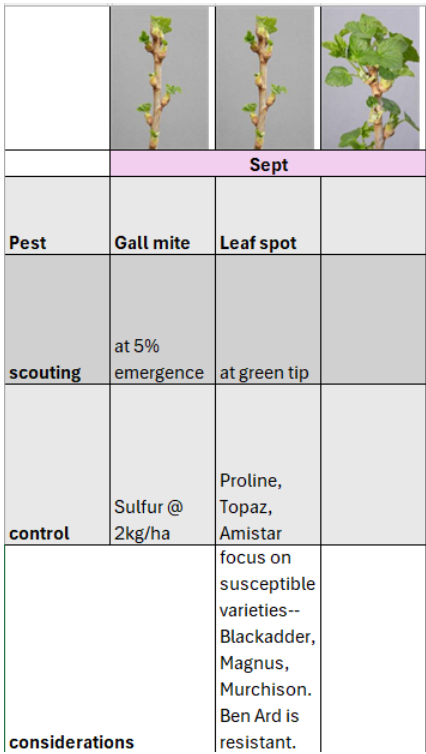
Gall mite: We have found that after cold winters, gall mite emerges early, in the last week of August, much earlier than the model predicts (see https://www.berryworld.co.nz/blog-posts/commentary-on-the-gall-mite-model). This was true in 2024 and in 2017.
It has been a cold winter for 2026, so we should be prepared for an early gall mite emergence, and therefore an early target for sulphur sprays. We will be checking the galls at the Lincoln plot, to ground-truth this, but we’re already seeing a few “poke their noses out” so we suspect by the first week in Sept when the temperature warms up they’ll be coming out. The goal is to have the sulphur on the outside of the buds just as they’re beginning to emerge so that in the next several weeks as they continue to dribble out, they get a dose of sulphur and die.
If it was me, I’d be temped to use a sticker with the sulphur so it stays on better through rain (although not an oil, and not a penetrant), but only if there are no green leaves out as I’d be worried about causing damage to foliage if sulphur get into the tissue. Microthiol disperss label also suggests using a wetting agent for hairy leaves (which blackcurrant buds are). Check the specific product label you have for any precautions.
Leaf spot: Green tip is the best time frame to stop leaf spot in its tracks. This is because the first tissue that emerges is susceptible to infection from the spores being ejected by last year’s leaves which are on the ground in the orchard. We can’t see those first tiny infections (they take 10-21 days to show up) but they are the source for all the later season leaf spots that we can see in the canopy.
See last season’s article for more details: https://www.berryworld.co.nz/blog-posts/lessons-from-the-past-installment-3-leaf-spot
From the blackcurrant production manual:
Work in the early 1980s on this disease showed that key times for ascospore release were prior to flowering. Therefore good control achieved in the early part of the season makes control over the remainder of the season much easier. Warm, wet weather and use of overhead irrigation encourages disease spread. Chemicals for control can be divided into two main categories:
There is a place for both types but the difference is important. The first group should be used when spot levels are low or when conditions are generally dry. Use the second group at peak spore release time of late September, or on non-fruiting bushes where a protectant spray has been missed and rain has recently fallen. Azoxystrobin and penconazole should always be combined with a protectant to reduce chances of resistance developing. Frequency of spraying will depend on the weather and the level of infection carried over from previous seasons.
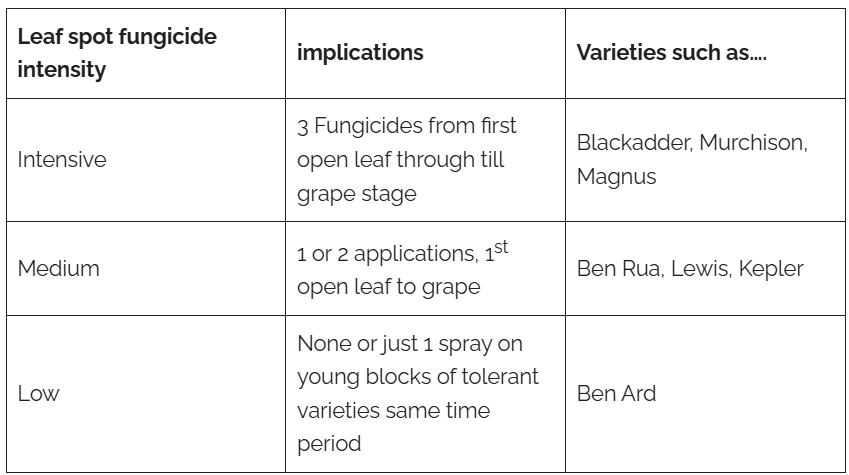
There is also a range of susceptibility by cultivar with Magnus and Murchison most susceptible. Ben Ard is tolerant.
After flowering, chemical choices are restricted. Check with the updated industry approved list before choosing a chemical.
We know from the spray diaries that many growers are habitually coming in with their Amistar or Topas or Thiram sprays too late to prevent these early leaf spot infections. Our present thinking is below: