
Your trusted source for independent, high-quality, science-based advice
© 2025 Berryworld, All Rights Reserved

We’ve been noticing a fair bit of calyx tip burn in the developing trusses of late. After a closer look at the situation, we can see that the king berries are affected the most and also a few leaves have marginal burning.
Calcium deficiency is causing this browning.
Calcium is used to build strong cell walls as plant tissues are developing in primordia, when the cells are tiny and not yet expanded by turgor pressure. If the walls aren’t built strong enough, when the cells start to take on water to expand (the process which accounts for the majority of the leaf growth), the cell walls break under that turgor pressure, resulting in dead cells.
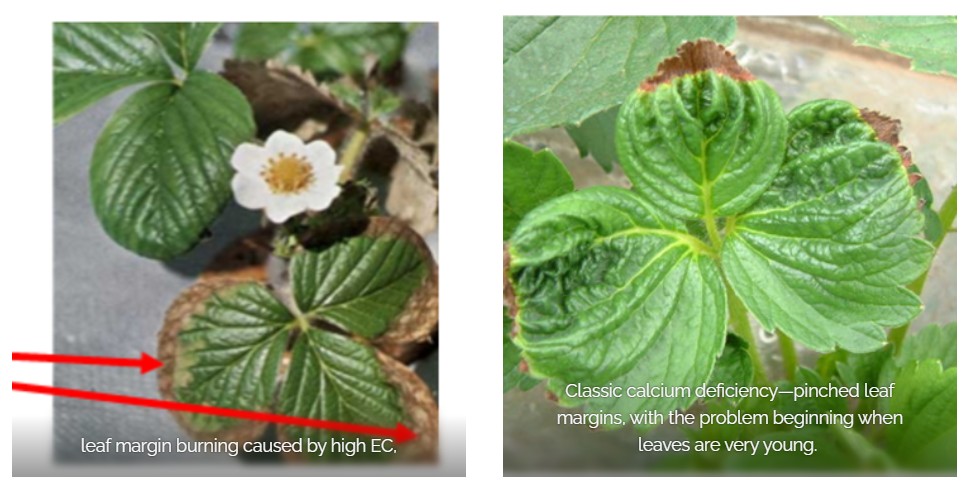
Sometimes leaf margin burn is due to high salts in the media, but that tends to be after the leaf has expanded normally. Calcium deficiency causes that “pinched” look where the leaf margin died when the leaf was quite young, and the leaf has continued to grow and buckle around the browning.
Do I fix Calcium deficiency by putting on more Calcium?
It’s all well and good to say that it’s a calcium problem, but calcium is a tricky nutrient to understand. Deficiencies in plants are usually NOT because there is insufficient calcium in the soil. In fact, I’ve had good calcium leaf levels in all the monthly leaf tests. Calcium deficiency is all about transport hitches, and short-lived ones at that.
Plants don’t actively scrounge around for the calcium they need, like they do for nitrogen. They accumulate it passively, as they are drinking water through their roots and transpiring it out through leaves. The window for putting calcium into cell walls of meristem tissues (actively dividing cells) is short, so a hiccup in the transport system at a critical time can lead to a localized deficiency in the cells that were being built at the time, while the overall level of Calcium in the plant and in the soil is adequate.
The frustrating thing about calcium transport is that all kinds of conflicting reasons can cause these transportation hitches:
Gargh! It all seems very confusing and contradictory.
My learnings this time come from a Cornell University publication (https://www.e-gro.org/pdf/E601.pdf) that says strawberries are different than lettuce, another crop plagued with calcium problems. In strawberries, once leaves are expanded, they rely on transpiration to pull calcium up from the roots. However, when the leaves and flowers are tiny and tucked up, they rely on a completely different mechanism to get the young developing flowers and leaves. They rely on “root pressure” to push liquid containing calcium up to the young tissues.
We’ve all seen those “guttation droplets” on leaf margins in early morning. Turns out it’s not a bad thing, it’s actually the mechanism that pumps calcium to young tissues that aren’t yet big enough to be transpiring.
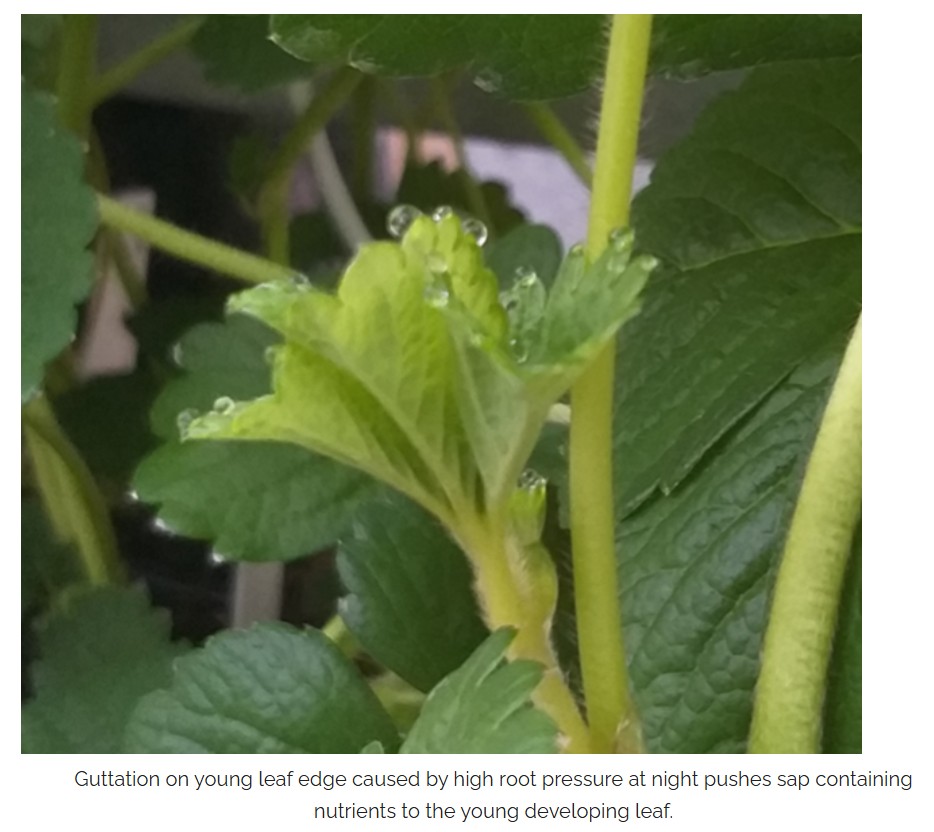
In my case, I believe a lack of root pressure at high has led to this calcium deficiency. I have been running the night time soil moisture on the low side. There was one night in particular on 11th January when we had a norwester all night--low humidity and windy. The soil moisture tracking showed the plants were transpiring rapidly all night. It was about 2 weeks later that I was noticing a lot of calyx burn on the young green fruit…these were probably flower trusses just emerging from the crown during the norwester.
Subsequently, conditions have improved and there is far less calcium deficiency in the new leaves. I’m also running the soil moisture a little higher.
Calcium is a tricky one, and deficiencies can be caused be several different factors. Trouble-shooting on farm should involve a check of media pH, EC, moisture, humidity and root health.
Some growers see the marginal leaf pucker caused by calcium deficiency and worry that the damage from cyclamen mites feeding. Cyclamen mite feeding does not tend to cause brown leaf margins. See https://www.berryworld.co.nz/blog-posts/cyclamen-mite for photos.