
Your trusted source for independent, high-quality, science-based advice
© 2025 Berryworld, All Rights Reserved

Since releasing persimilis (Bioforce calls these spider mite specialist predators “Mite E”) on 22 Oct, I’ve been pacing the tunnel, anxiously hand-wringing like the proverbial mother hen. See Spider Mite Battle: Episode 1, Predator Release for the beginning of this saga.
“Can I find ANY persimilis?”
“Gosh, there’s a lot of spider mites!”
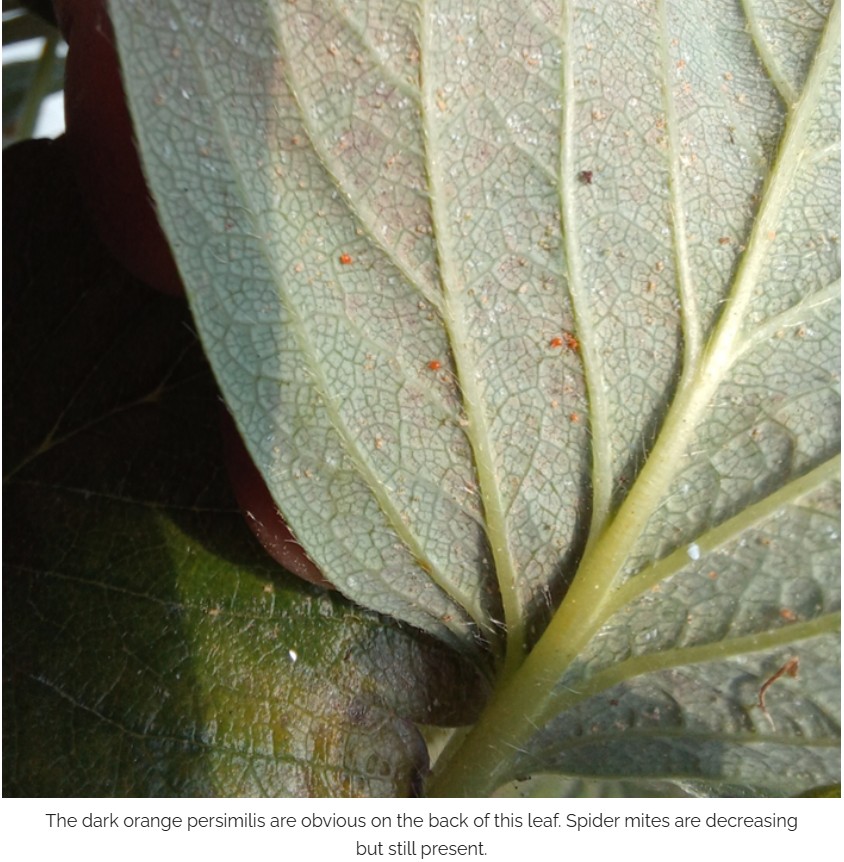
“Ooh, I see two good guys—where are the other 998 I released?”
“Wow, spider mites sure are prolific—eggs galore”
“There’s a persimilis egg! At least one of them is making babies.”
You get the gist. Anxiety. Anxiety and much peering through my 10x lens.

Note that the persimilis babies aren’t as orange as adults, so can be easily overlooked.
Geoff, of course, was sanguine. As he says, its calming when you can’t actually see the mites 😉 Plus, he has seen the predators work many times before. His faith is strong, and he has patience…both qualities I am somewhat lacking.
Timeline of field observations

It took almost 5 weeks before I felt the tide had turned. We still have spider mites, but now almost every leaf also has predators, and lots of predator eggs. A few leaves have more predators than spider mites. I believe that the predators will win.
We had a few extra spaces amongst the trial plots this spring, so I planted some troughs with alyssum and marigolds. I want to be a hippie companion plant gardener.
Just kidding.
There are theories about attracting beneficial insects with the nectar resources in alyssum, which I wanted to test out first hand. Strawberries make rubbish nectar resources for pollinators and therefore aren’t particularly attractive to bees, as anyone who has both raspberries and strawberries will attest. Marigolds are excellent hosts for thrips, so I wondered if they could attract thrips predators as well.
The jury is still out about whether this approach will impact the pest pressure in our trial, but at least I’ve seen some hoverflies. As adults, these flies feed on nectar. However, their babies are meat eaters. Fly babies are maggots…cute.

When we spray insects, we’re used to assessing whether or not the spray worked within hours or a couple days at the most. When relying on predators, it’s a much longer game and the useful observations are in stages.