
Your trusted source for independent, high-quality, science-based advice
© 2025 Berryworld, All Rights Reserved

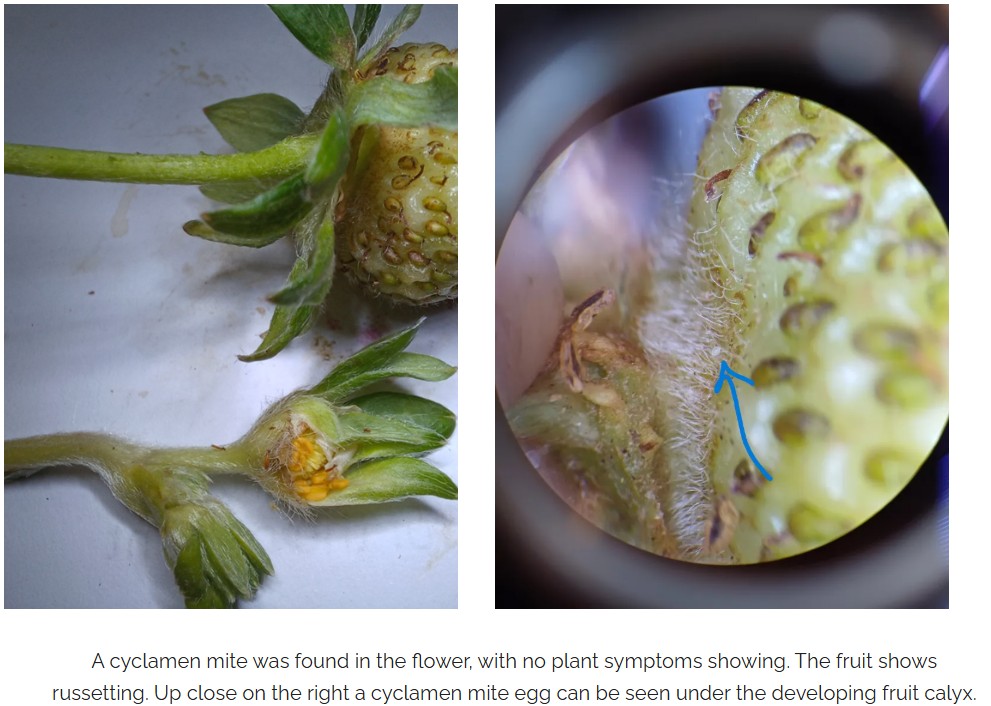
This is the first season in a long while that we’ve had cyclamen mite in the Lincoln trial. Given the level of problems in the industry in the past season, we’ve been making some close observations.
Russet fruit
Our first sign of cyclamen mite was russetted fruit in late December. This matches what an observant strawberry grower told us. He sees the symptoms first on fruit, well before he can see any signs of crinkled leaves.
The fruit symptoms are visually indistinguishable from those caused by thrips, as both insects are feeding under the calyx. A microscope or good hand lens is required to determine the culprit.

Prickly trusses
While reading about cyclamen mites from ADHB in the UK, they were citing “toothed flower trusses” as a symptom of cyclamen mite feeding. (https://horticulture.ahdb.org.uk/knowledge-library/tarsonemid-mite-on-strawberry-crop-damage) Low and behold, we do have those in our trial, in certain plots where we suspect the problem started. Most of the fruit in these plots are still fine.

Our present thinking is that the “prickles” on flower trusses could be an early warning sign of cyclamen mite feeding in the crown. We still have no appreciable leaf symptoms in the trial plants, even though when I carefully comb through the folded leaves, I can find at least one mite (or an egg) present on half the plots I check. Obviously it takes more than a single mite feeding to cause visible symptoms.
Timing of symptoms
I originally thought this was an infestation that came from the surrounding environment of our trial in Lincoln. We planted in June and saw the first symptoms in December, 6 months later. But now I’m not so sure.... there are a lot of questions around how long it takes to see the first symptoms of cyclamen mite feeding after a single mite has managed to sneak into the strawberry crown and start reproducing. This undoubtedly varies greatly depending on temperature and on predation, and we don’t yet have hard answers.
We’ve described the life cycle in an earlier article (https://www.berryworld.co.nz/blog-posts/cyclamen-mite).
We know that cyclamen mite spread is quite slow because they don’t like to be out in the sun and dry air. They can get moved with workers handling plants, birds, bees and equipment.
One thing we do know is that when cyclamen mites come with the plants, the effects are much more serious than those of later infestations that can happen post-planting at the fruiting field.
End of season clean-up: preventing spread
Many growers this past season will have had trouble with cyclamen mites. Some may not have recognized what was causing the problem. One thing we do know is that cyclamen mites will overwinter in plants and be there in even greater numbers next year. This is not a good year to keep plants for a second year.
However, we also know that a dump heap of plants can be a point source for infesting next year’s plants. We’ve actually seen this happen in the past. Keep this in mind as the plants are being removed and new plants planted. Plants should be buried (and left covered for several months until they are fully dead), burned, or in some other manner completely removed from the site before new plants arrive on the property.