
Your trusted source for independent, high-quality, science-based advice
© 2025 Berryworld, All Rights Reserved

This was the third season of insect scouting sponsored by BCNZ in select blocks across Canterbury. Scouting was done by Pete McNaughton from Fruitfed seven times on 9 Canterbury blackcurrant farms over the season from late October to mid-March. The same blocks were used as in the 2023/24 and 2024/25 seasons, middle aged Ben Ards, except for one switch at Ashburton. Scouting looked at aphid, spider mite and scale numbers, the severity of plant damage caused by aphids and by spider mites, and the numbers of several key beneficial insects.
Scouting was done by walking through a block and stopping at 8 random locations, and noting pests and beneficials found on 5 plants at each stop, for a total of 40 plants observed per block. Plant damage ratings were assigned as per rating scales outlined in the appendices.
Rather than drop the whole report at once, we'll pull out sections that are bite-sized pieces. The whole report is available upon request from BCNZ.
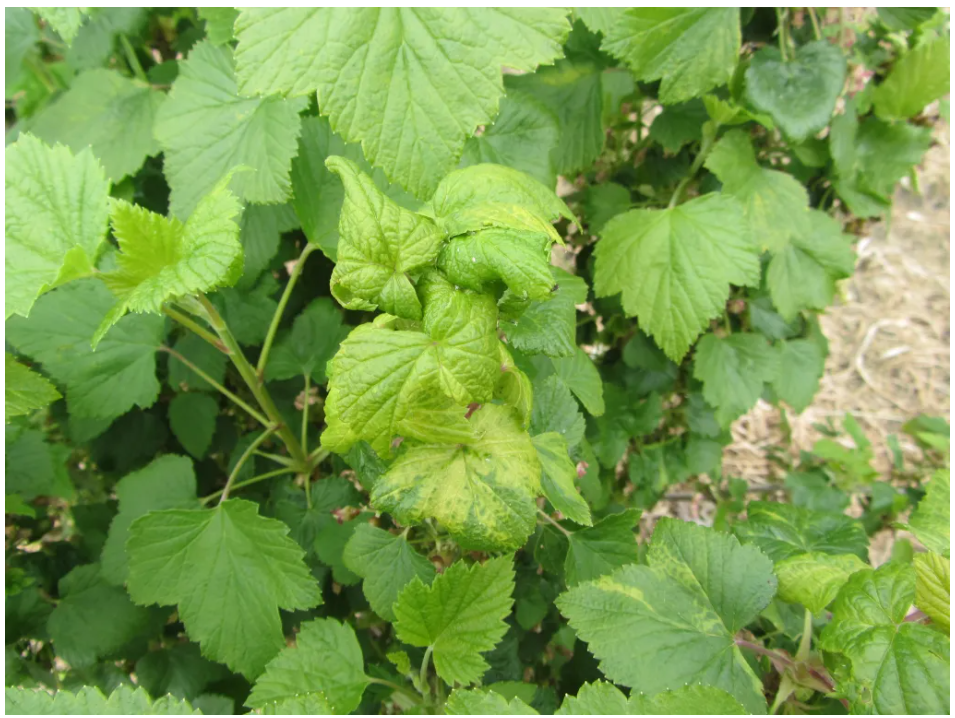
Compared to the 2024/25 season, the 2025/26 season had lower aphid pressure which appeared later in the season, peaking in the second half of December rather than in mid-November as it did in 2024 and 2023. Pete said this trend was similar to aphid pressure in other crops, probably reflecting the weather conditions over the region. Appendix 1 contains a tabular summary of aphid scouting results over the season in Canterbury.
Five of the farms applied aphicides, while the other four did not. Notably, aphid sprays (Pirimor and/or Transform, mostly) were put on significantly before the peak in pest numbers and damage. Three of the 5 farms that sprayed did so in October, well before scouting showed pest pressure. The remaining two farms sprayed at a pest damage level of 1, and scouting showed both pest numbers and damage to continue to increase after the chemical application. This is not a new trend—we saw the same thing in the 2024/25 scouting season.
Aphid numbers appear unaffected by spray applications, yet the populations eventually go down.
The picture we see is that while growers are spraying for aphids, aphid numbers and plant damage continue to worsen after the spray, and eventually pests “clear up” despite no more insecticides being used. It appears that pest pressure abates despite sprays rather than because of sprays.
Aphid resistance to Transform is known in Australia, and various aphid species have long been documented to have resistance to Pirimor in NZ. It’s possible that we’re experiencing pesticide resistance. Alternatively, given the known challenge with getting under-leaf coverage of sprays, especially after leaves have curled downward due to aphid feeding, it may be that we aren’t reaching the aphids with the sprays that are applied.
Aphids may be leaving blackcurrants for their summer hosts, or being eaten by predators.
Blackcurrant aphids (Nasonovia ribisnigri) are slightly unusual in that they overwinter as eggs. These are laid on the bushes in April/May by returning mature adult females. The eggs are very hard to see. When the aphid species was new to NZ and being studied (2002), hatch time was found to be early October, and population numbers built up until late November when they all flew away to their secondary hosts (hawksbeard, chickory, etc). To complicate matters, the lettuce aphid is also known to also overwinter in sheltered/warmer areas in their asexual (clonal) form. The other aphid species to feed on blackcurrants is the sowthistle aphid (Hyperomyzus lactucae), with a similar life history to lettuce aphid.
Dispersal: For two years in a row, the scouting data shows that once more than 50% of the colonies contain winged aphids, the plant damage to blackcurrants doesn’t get any worse. The reason aphid numbers go down by late December may simply be that they are dispersing to their summer hosts.
Predation: We can look at the predators that could contribute to declining aphid numbers by graphing the pests and the known aphid predators over time.
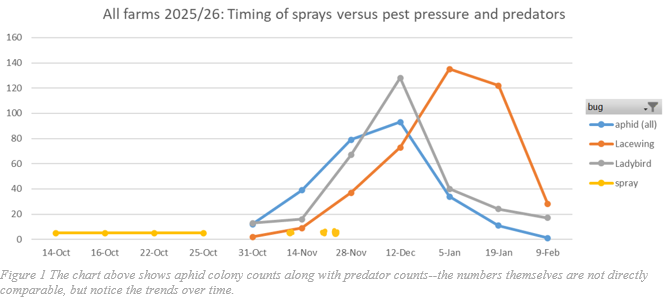
While the chart above shows the Canterbury farms as a whole, individual farm graphs look very similar (see Appendix 2 in the full project report).
All the pest and predator activity is peaking well after sprays are applied.
Ladybird numbers peak about the same time as the aphid colonies, with aphids declining as lacewings are peaking. It’s unproven whether the predators are contributing to the aphid decline, but in other crops where aphids do not disperse (like lettuce or potatoes), predators are important to aphid population control.
Reviewing the impact of our aphid sprays on predators, Transform is moderately harmful to ladybirds and lacewings, while Pirimor is safer. However, our data doesn’t show that predator numbers are consistently higher on unsprayed blocks. Predator numbers seem more related to the numbers of their prey (aphids) than to sprays.
Why are growers spraying for aphids if their sprays seem ineffective?
Three strategic approaches to aphid control are possible, and could be tested:
Recommendations: