
Your trusted source for independent, high-quality, science-based advice
© 2025 Berryworld, All Rights Reserved

It’s been interesting watching the EC fluctuations in our strawberry tabletop system this season. EC is a gross measure of total salts, so it is a useful proxy for strength of the fertilizer solution.
Our record keeping has highlighted that while I might set the inward EC to be a certain level, what the root zone is experiencing is often completely different.
We track the EC in and the EC out (drain EC). We also track the volume of the drain water, and the moisture levels in the media. I’m parsimonious by nature, so my goal was to keep the moisture and EC in the root zone on target while losing as little as possible out the drain. The drain water gets collected and watered to other plants.
I quickly discovered that if I feed an EC of 1.2, what I might be aiming for in the root zone, the EC in the drain climbs above our target, which was 1.6.
When I calculate our drain percentage, it ranges between 2% and 9%, averaging 4% over the season total. Thank you to Tau Research for the drain tracking—we rigged up a rain gauge to record the water draining from our tables, and the tracking can be seen on the Tau dashboard, and the data downloaded for analysis.
If the EC is climbing in the root zone, it means the plant is transpiring water through its leaves as it grows and cools itself, and leaving fertilizer salts behind. It’s not using as much fertilizer as I’m giving it, but it’s using all the water available.
A drain percentage of 4% is very low, and many advisors would say that I’ve not been watering enough, and perhaps my plants were too dry. They might be right—I had a couple points especially early in the season when I accidentally let the plants get too dry. But for the majority of the season, I was happy with the soil moisture, which I track using a soil moisture probe as well as validating it by the “squeeze test” (by hand).
The conventional approach would have been to maintain the target EC in the supply at 1.6 but increase my watering schedule, which would flush out nutrients. However, I’d lose more nutrients in the drain water, and I don’t have the facilities to recirculate those.
So I thought, if the EC is climbing in the root zone, how about I turn down the dosatron and feed a weaker brew? It seemed to work, and by mid summer, I was feeding a stable 0.7-0.9 and getting 1.2-1.5 out in the drain. Happy days.
Surprises still happen
Occasionally, I water clear water into the plant troughs with the hose--like if it’s a hot Norwest afternoon and the regular irrigation schedule isn’t keeping up. I noticed that in those “flushes”, the drain EC would often be much, much higher than the regular drain. Concerningly high. Where was all that extra fertilizer coming from?
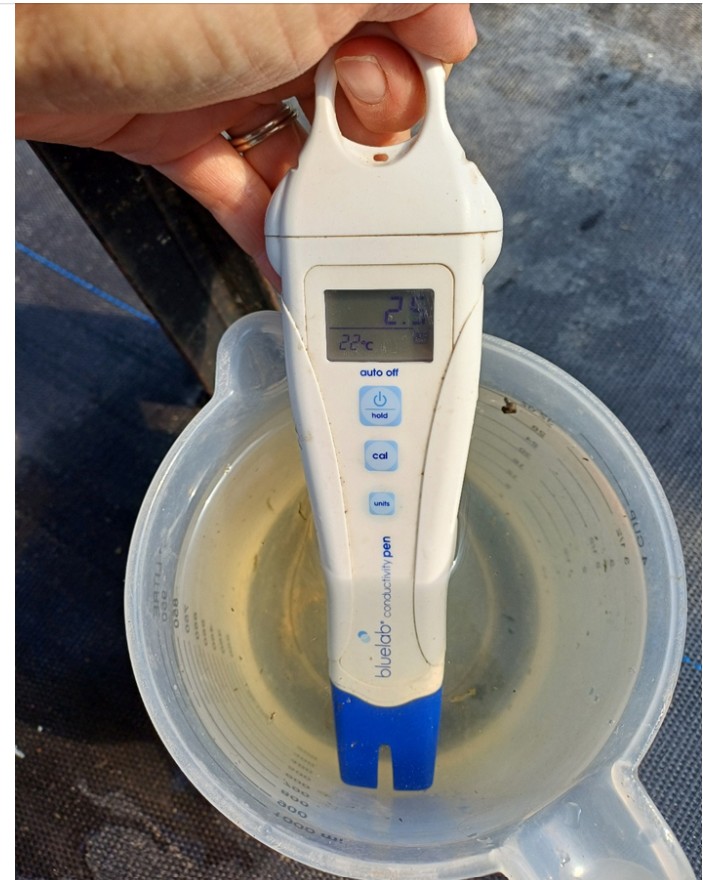
Bert from Bert’s Berry Plants said he sees this often at farms. He explained that if we’re continually feeding through drippers and those drippers aren’t entirely wetting the media, then the salts accumulate at the edge of the wetted zone, where the water is used and the salts are left behind. It’s like walking at the beach and wetting the bottom of one’s trousers with salt water; there’s an extra concentrated salt line that wicks up to just where that salt water dries.
In this situation, the drain water is not representative of the EC in the entire root zone, unless the root zone is fully wetted and can rehydrate and flush out those salts in the drying zone. Obviously, my tight watering schedule was not doing that, and my overhead water flushed those extra salts.
If strawberry leaves are getting burnt margins around the edge, but the drain is still EC 1.5 or lower, try flushing the containers with fresh water. It’s possible that the drain is underestimating the salts in the root zone.

Going forward:
Maybe my approach to EC management has left my plants hungry for something…while we were mostly satisfied with our yields, our average fruit size was a tad lower this year than in past years. Perhaps I’ve missed out on some yield or fruit size with my parsimonious approach?
EC is a total measure of salts, and doesn’t tell me what nutrients are making up that total. I’m wondering if my plants, when fed with a low EC, were using all the nitrogen available to them. If that was the case, my drain water would be lower in N, proportional to the other nutrients, than the feed water.
Next year, I’m going to try a hand-held single ion measurement tool, which will let me measure the concentration of nitrate and potassium separately. I can learn in more detail what my plants are using versus letting slide out the drain.