
Your trusted source for independent, high-quality, science-based advice
© 2025 Berryworld, All Rights Reserved

Thrips biology and control options
Thrips in strawberries have been a persistent challenge. In large numbers, their feeding underneath the calyx of the developing fruit causes russetting/bronzing.
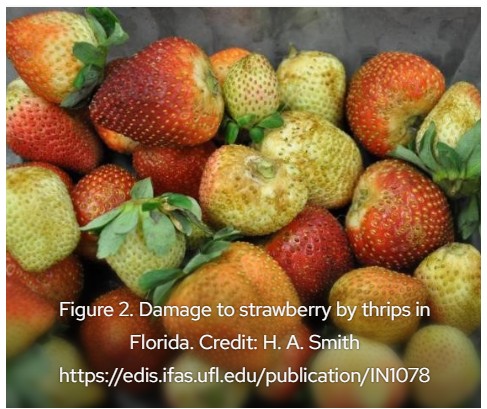
As is common with insects, thrips populations build up much faster in the hot weather of summer. And thrips can build up to VERY large numbers indeed.
Here, we are focusing on thrips that live in flowers (pollen is the protein source that they use to make babies). Western Flower Thrips and Intonsa Thrips are two examples that have been problematic in strawberries.
Why do they come in such massive numbers?
In summer, egg hatch might take 5 days, the two nymph (juvenile) stages another 1-2 weeks (1 week at 25°C, 2 weeks at 20°C), followed by 3-5 days as a pupae in the soil. That makes 3-4 weeks generation time, with females laying up to 200 eggs. We all remember exponential growth curves from the Covid infection days—this is why thrips numbers balloon so fast. We reviewed which stages are susceptible to which controls (both sprays and predators) here.
Where do they come from?
Thrips can get blown into strawberry fields from neighbouring crops, but work done by Landcare Research in spring 2024 showed that in west Auckland, the thrips population was actually building up in strawberries from quite early in the spring—we can’t blame our neighbours for our thrips problem.
What regions see damage?
The severity of the thrips damage in strawberries seems to vary quite a bit around the country. Auckland, where something like 80% of our strawberries are grown, cops it hard. Hawks bay, Bay of Plenty, Hamilton and Nelson have pressure as well. Kapiti and Canterbury don’t seem to have as severe an issue. We suspect that factors like variable spray coverage and differences between individual growers’ tolerance for thrips in flowers are contributing to some of this variability in reported success with on-farm thrips control.
There are three main strategies to consider: mass trapping, chemicals, and predators.
Mass trapping
Sticky traps (yellow or blue sticky tapes) only catch adults, as nymphs don’t fly. Trapping alone doesn’t prevent crop damage, but it can reduce damage by around 50%, though results are variable (info from the UK). If an attractant is used on the sticky tape, damage reduction is reduced even further. If good biocontrol is in place already, traps are not very impactful (biocontrol is doing the job already).
Chemical control
Control with chemicals is a challenge both because the place where thrips develop in strawberries (under the tightly folded calyx) is hard to reach, and because thrips are notorious for evolving resistance to chemistry. A complete breakdown of chemical control because of pesticide resistance was what triggered the change to predator-based control in Victoria. We haven’t gotten to this stage yet in NZ, but one thing is certain; the chemistry we commonly use won’t last forever.
Chemical control options are listed on the SGNZ industry spray list. Options range from single-site active chemicals like Spinosad, Sparta, Benevia and Sevin to alternatives like azadirachtin (insect growth regulator) and Beauvaria bassiana (fungus that kills insects). The juvenile thrips that do damage are tucked tightly under the calyx of the developing fruit, so coverage is a challenge.
Predator-based control:
Neosilius cucumeris, combined with soil-dwelling hypoaspis mites (targeting pupae), are the predatory mites used for control of thrips in NZ. We don’t have some of the other predator mite options that are available in other countries, but the Victorian strawberry industry managed their thrips successfully with just cucumeris in their early biocontrol years, so it’s possible. Landcare Research, in their recent strawberry study, found that cucumeris ate Intonsa thrips as well as Western Flower Thrips.
There are differing opinions about how compatible the commonly used chemicals are with predatory mites, and the Australian experience is that under cover sprays can be more harmful to predators than in the open field. We often look to Koppert’s chemical compatibility database for guidance, which says that Spinosad and Sparta are pretty hard on cucumeris, while Benevia somewhat less harmful.
Australian control has since been made easier with the Orius tantillus predatory bug. While we don’t have this species in NZ, we do have B. whiteii, a similar predatory bug species. Landcare Research found whiteii to be effective in reducing thrips numbers in the recent strawberry pot trial.
The key is early establishment of predators because they don’t eat adult thrips; their function is mopping up the babies in order to prevent population growth. This is true for both predatory mites and predatory bugs. This also means thrips number will never be zero in a predator-based control system. Also, these predators need warm weather to really thrive. While Bioforce says cucumeris needs 20-25°C to prosper, they seem to be doing well in my tunnel at Lincoln where night temperatures are in the low teens and day temps are generally above 20°C.
The next article will be on counting thrips.