
Your trusted source for independent, high-quality, science-based advice
© 2025 Berryworld, All Rights Reserved

How many thrips are too many?
Since having zero thrips in flowers in impractical and unachievable, the next question is how many thrips can we tolerate?
In the UK, two different thresholds are used. If predatory mites are established, there can be as many as 10 thrips per flower before fruit damage is seen, so 10 thrips/flower is the threshold. Remember, predators are eating baby thrips which are feeding under the calyx of the young fruit, not the adults in the flowers. If predators aren’t established, they find that fruit will be damaged with only 5 thrips/flower, so this lower threshold is used for control measures.
Counting thrips
In our variety trial, I blow gently into the open flowers, choosing flowers that have shed their pollen already (anthers darkened) but still have all their petals. Counting the thrips that scuttle around, I realize how variable these numbers are, and why the threshold must be an average of counts from at least 20 flowers. It’s not sensible to make control decisions based on single flowers that are loaded with thrips—the control measures are applied to the whole block, so the counts should be too.

What kind of thrips do I have?
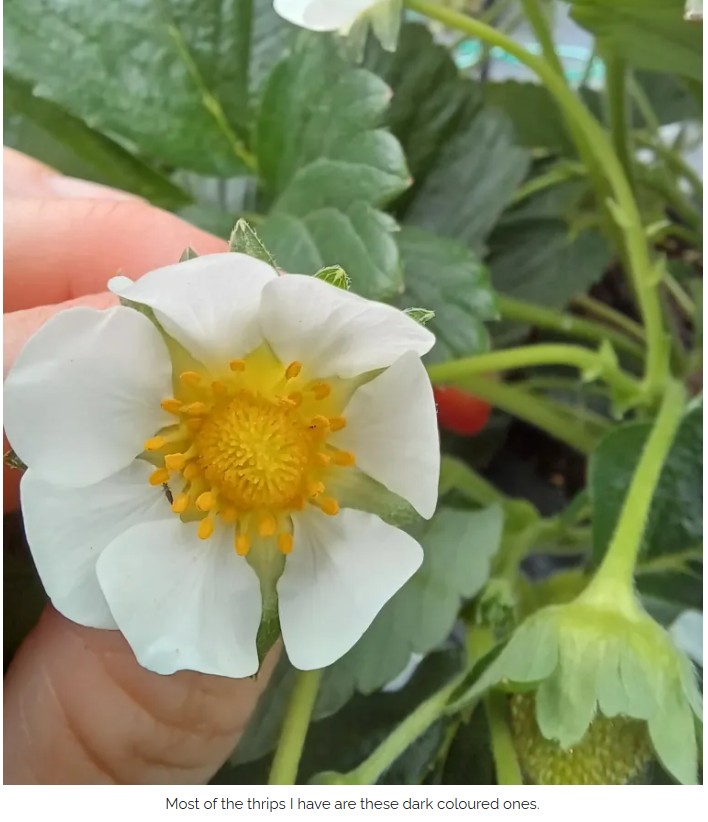
The complicated truth of biology is that strawberry flowers can host many different species of thrips, and that not all these species do damage. I would like to know which species I have. Most of mine are black with light patches on the thorax-end of their wings, so not Western Flower thrips or Intonsa thrips. The practical limitation is that thrips identification is a skilled lab job (think counting hairs on the foreheads and legs of slide-mounted adult thrips), and that the species mix can change rapidly through the season anyway. This leads us to the pragmatic short cut of scouting under the calyx of developing fruit. If thrips juveniles are there, whatever their species identity, high levels of feeding will cause fruit damage. Also, under the calyx is where the predators should be feeding, so their presence is assessed at the same time.
Step 1: Weekly thrips counts in flowers will show the trajectory of the population whether it’s increasing or decreasing
Step 2: Under-calyx checks will show whether the thrips are feeding where they can cause damage (ie: they’re a species that matters), and whether predators are active
Scouting for predatory mites and thrips under the strawberry calyx takes good eyesight and a 10x lens, but thankfully it falls short of rocket science. Growers who struggle to see tiny things will need to delegate this task.