
Your trusted source for independent, high-quality, science-based advice
© 2025 Berryworld, All Rights Reserved

We are getting new information from California about winter chill in strawberries. Mark Bolda (University of California) has been working to understand what happens to the strawberry plant physiology when it is chilled.
Turns out that there are two phases of plant response to winter cold.
Phase 1: Starch accumulation in the crown—this happens in response to shortening days and cold temperatures (0-7°C). Naturally, in temperate climates where strawberries originate, this happens in outdoor ambient temperatures in autumn, and can be viewed as the plant “packing on calories” to save for spring growth before it goes into dormancy.
Phase 2: Conversion of stored starch to sugars—this happens in response to dark, steady cold, such as a plant in a mid-latitude winter would experience under snow cover. It
readies the plant for rapid spring growth. Maybe it also increases the plants’ cold tolerance, as in some winter greens like spinach where the sugar accumulation acts like an antifreeze, preventing ice crystals from forming inside cells.
For phase 1, maximum starch accumulation has been reached after about 280 hours (12 days) of late autumn conditions. Extra cold conditioning doesn’t increase starch reserves after this.
For phase 2, we sometimes give plants supplemental chill in a cooler, which simulates this deep winter dormancy. During this phase, the plants’ starch reserves are rapidly broken down into sugars.
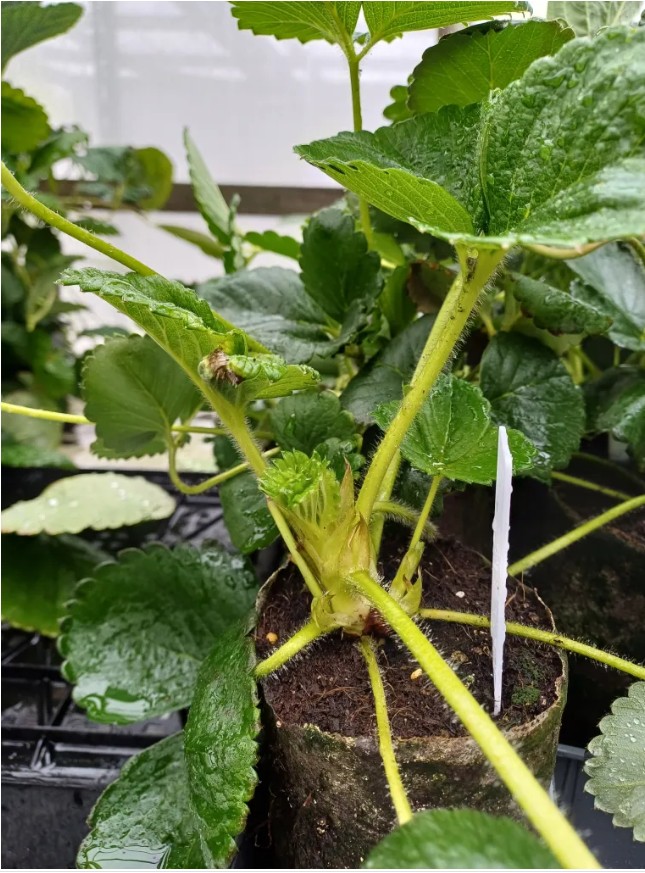
A new study in California has shown that for all varieties, the supplemental chill increases runner production the next season. Monterey, a variety that genetically makes lots of runners at any time, produced an extra 30% when given two more weeks of chill in the cool store after the 280 accumulated on the nursery floor. That’s not exactly desirable if you’re a fruit grower!
For other varieties, the story is a bit more mixed. Golden Gate produced the highest yields with two weeks of additional chill after the 280 hours in the nursery, but also made 63% more runners than plants that had only the nursery floor chill, so a trade-off between highest yield potential and runner production. Keystone made the highest yields and the least runners without any supplemental chill (post 280 hours in nursery), so that at least is a clear win.
This new information has led us to update our recommendations around chilling the UC Davis varieties, and is a move away from the old blanket recommendation of giving 500 hours of chill to all day neutrals.
We have some historic data on Auckland winter chill, and it’s variable year to year. In some years, Auckland barely gets 280 hours of chilling, while in other years more is accumulated. In these marginal chilling climates, microclimates (slope direction of land, elevation in the local landscape, etc) can also make a big difference to whether natural chill in June-planted strawberries is optimal or not. Historically, local Auckland growers found that some varieties such as San Andreas benefitted from 2 weeks supplemental chill before planting.
We now suggest that for most varieties grown south of Auckland in NZ, and grown outdoors or in an unheated, well-vented structure, supplemental chill (meaning in a chiller) may not be required. The amount accumulated naturally during the winter will probably be enough.
Of course, there are still heaps of unknowns. A short list:
So, what do we do with all those unknowns?
This is where local trialling comes in. As annoying as it is, the best data will be generated by growers willing to split their plant order, giving supplemental chill to some and less or no chill to others.
We would be happy to help growers come up with a streamlined strategy to assess such trials. Assessments could be counting runner numbers on a small section of bed as they are being removed, and tracking fruit yield.