
Your trusted source for independent, high-quality, science-based advice
© 2025 Berryworld, All Rights Reserved

Several growers have remarked at the higher than normal scale numbers they’re noticing this spring. It’s gone from a back-burner issue to a front-and-centre problem for some growers.

“Scale is insidious,” Geoff says. It almost comes out in a hiss…. “INSIDIOUS”. What he means is that it accumulates gradually, subtly, but eventually the effect greatly weakens the plant.
The scale we’re seeing is probably Brown Soft Scale (Coccus hesperidum), based on identification done last year by the MPI lab. Previously, the most common scale species has thought to have been Lecanium scale (Parthenolecanium corni).
The “scale of the year” (brown soft scale or Coccus hesperidum) has 3-5 generations, and each female can make up to 200 eggs. They are all are females—efficient from a reproductive standpoint. Imagine that exponential population growth potential. In contrast, Lecanium scale is thought to have only one generation per year.
While Brown Soft Scale can feed on many host plants, they are typically not present in epic numbers due to parasitism by tiny wasps and other predators. Clearly the parasites aren’t doing very well in our cultivated black currants at present.
The time to control scales is when they are ‘crawlers,’ which are the nymph stage. The adult’s shell protects them from insecticides, and they even stop eating as they mature and become egg-laying machines.
Right now, having looked a several fields, the first generation of eggs are just being laid under the protective covering of the mother’s shell. They’re basically untouchable there.
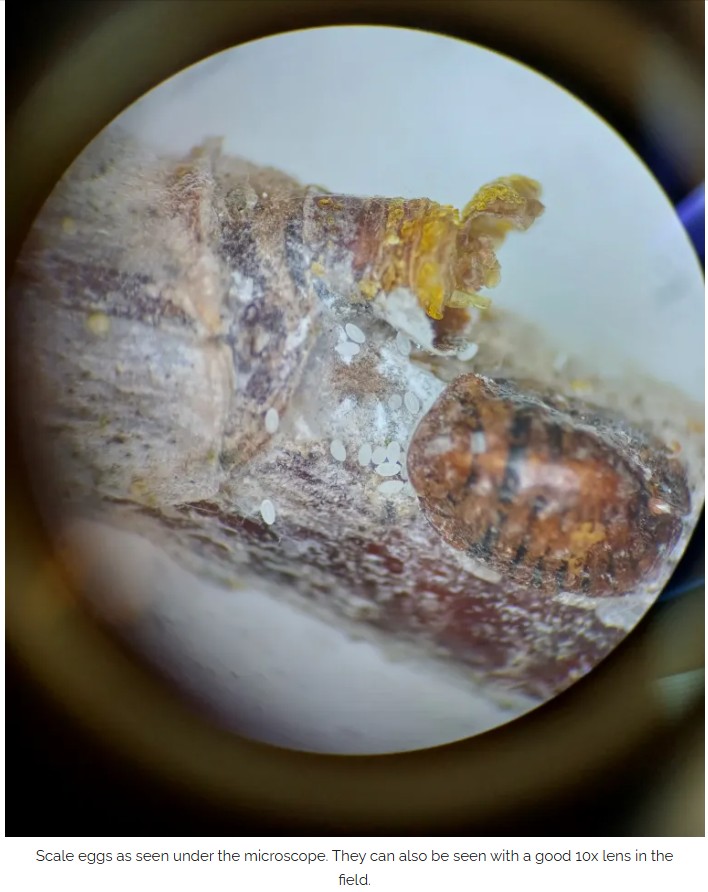
Soon (and I don’t know how soon), the almost-microscopic scale crawlers will hatch from the eggs and move up the plant to the backs of the newly growing leaves, where they tuck in along leaf veins, feed, and grow through three increasingly bigger nymphs and then into adults.

Several questions are bubbling up to date:
Buprofezin is an insect growth regulator, which means it interferes with the molting process between juvenile stages. Once an insect is an adult, an insect growth regulator doesn’t hurt it. In some cases, insect growth regulators might affect the viability of eggs, but only if it is taken into the insect body, and adult scales are well protected.
Geoff has had a look back at the spray diaries for the last couple of years. Most growers who use Ovation are getting it on along with an oil in mid/late August or even early September.
The relevant question is whether the scales have turned into adults by August or September. I don’t know, but we need to find out what stage is starting the winter and when they change into adults, because Ovation doesn’t work on adults.
This is a spray coverage question. All of our winter scale options (oils, Ovation, and lime sulfur) require excellent coverage, and the scales are often tucked up behind buds during winter.
Great question. In Australian vineyards and in California, the main predators of scales are tiny almost microscopic parasitic wasps. We don’t know which scale predators could be active in our blackcurrant blocks. We do have parasitoid wasps that will lay eggs in soft brown scale—in fact one was imported decades ago specifically as a biocontrol.
We’ve seen scale pressure that is highly variable in our scouted blocks over the past two seasons, and we don’t understand all the reasons for that.
For what it’s worth, Tavendale’s organic block had plenty of scale, so it’s not simply a matter of avoiding synthetic pyrethroids and everything comes right.