
Your trusted source for independent, high-quality, science-based advice
© 2025 Berryworld, All Rights Reserved

At our 9th February IPM workshop at Matamua farm with Paul Horne and Rebecca Addison, we walked into a nearby blackcurrant field and peered at an abundance of scale crawlers under the leaves. Unlike aphids, they don’t wiggle when you poke them, so we speculated about whether they were alive or dead, particularly as the field had been treated with oil and Ovation (buprofezin) in January.
Update: they were alive.
Both Sergiy and I have spent some time examining the tiny insects. It doesn’t work to poke them to make them move, even under a microscope. However, when the leaves they are feeding on begin to dry out (such as in a sample bag, held in front of the truck heater, or on a bouquet of infested leaves on my desk), the crawlers most definitely start to move. They go looking for greener pastures as their host leaves senesce.
https://youtube.com/shorts/Y2VF3krTnME?si=saJMcRKApt76c3zE
Thank you to Sergiy for the video!
How has the summer spraying gone?
Sergiy has spent a lot of time and energy spraying scale this summer. Trials have included different sprayers (drone, Bertolini, Agrifac (air-assisted boom)), as well as different active ingredients and adjuvants. Exirel (cyantraniliprole, same as Benevia) was used, as was Ovation (buprofezin, same as Mortar).
Frustratingly, nothing has seemed to have worked very well. However, since we don’t have an unsprayed control, we don’t have a way to compare what the situation would have been if no spray was used. Nevertheless, scale seems to still be very abundant on all the treatments, so nothing seems to be “magic.”
Spray coverage is limiting:
Sergiy’s observation has been that under leaf coverage is the limiting factor with Ovation, which needs to contact the insect and doesn’t enter the leaf. Even the Bertolini using 600L/ha of water doesn’t get underneath the leaves, particularly as the leaves start to curl downward.
Oil alone is quite effective on scale, if spray coverage is good. A study on this same scale species in vineyards found that in spring (before full leaf cover), an oil spray reduced the number of overwintering females from 2000 (on 10 canes) to 100. All of Sergiy’s Bertolini applications included 1% oil and 1% Oilmate (spreader) but we don’t seem to have done much to the scale crawler population, another confirmation that spray coverage was limiting.
What will happen to all those crawlers?
We gave a quick estimate as to how many scale crawlers were on a particular block of Ben Ard, on 30 March, 2026. Given an average of about 40 crawlers per leaf (based on counting 20 leaves), and a rough count of about 200 leaves/meter of row still clinging on this late into the autumn, we come up with a tally of 8,000 crawlers per linear meter of row. Wowzers! Truly a guess as to numbers, because scale seem to be quite uneven in distribution and we only did counts at one spot, but still impressive.
There must be attrition between now and spring. As the plant drops its leaves, we’d expect to see those crawlers move onto the canes to overwinter. Sergiy and I looked but hardly saw any moving yet. The crawlers really seem to prefer to stay on the leaves until the last minute. We observed some leaves that had just fallen off with crawlers still attached to them; presumably those aren’t going to live, but we don’t really know.
On the organic block, we observed some crawlers that were eaten by a fungus. Yay. To date that has not controlled scale in that organic block, but it's a useful observation.
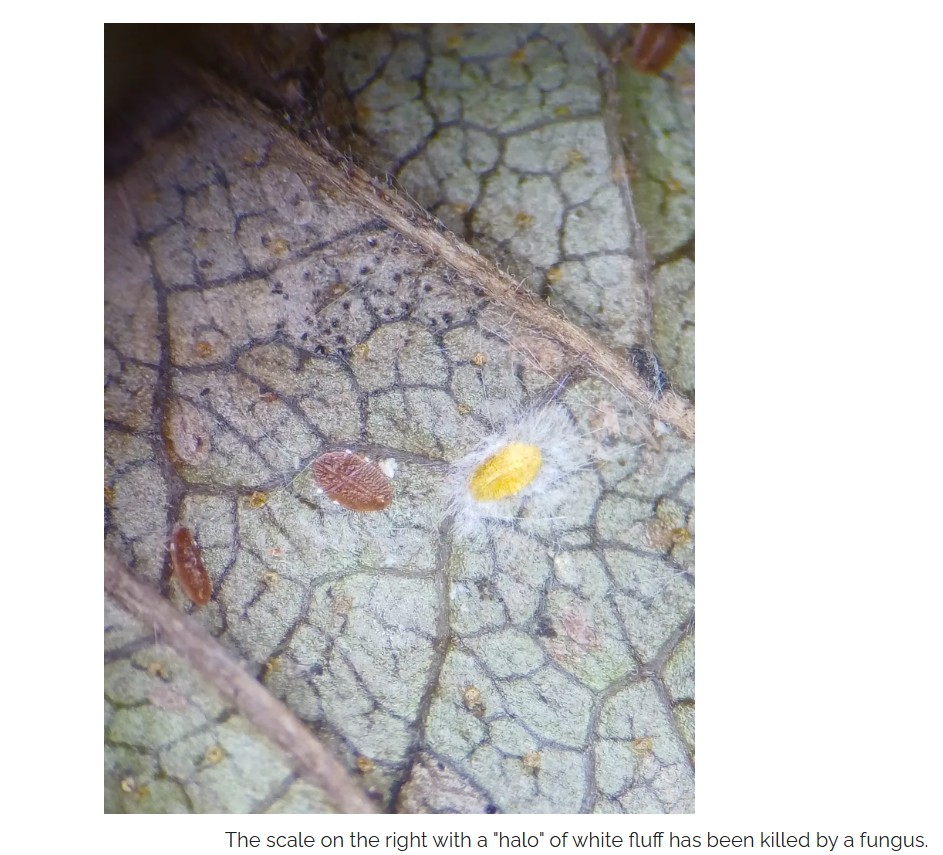
Sometimes entomopathogenic fungi (fungi that eat bugs) can absolutely devastate an aphid population, we've seen it happen. Interestingly, we saw none of the fungus-infected scales on conventionally sprayed blocks. We have submitted this sample to Plant Diagnostics to learn what fungus is helping us here.
Experience in other crops is that scale doesn’t normally become a big production issue.
Why?? Sometimes they're incidentally being controlled with insecticides targeting other pests, and other times the predators/parasitoids have taken them out.
Parasitoid wasps are usually some of the most significant scale population controls. Miniscule, smaller than the scale crawlers themselves, they can best be observed by a blackening of the scale nymphs that are parasitized.
I’ve looked two different times for parasitized scales in the Matamua organic block (October and March), and haven’t found one yet. Why not??

The other predators that eat scale crawlers are the tiny predatory beetles and their larvae, Stethorous and the like. We learned at the IPM workshop that Ovation, while it doesn’t kill Stethorous, prevents it from reproducing. Geoff talks about seeing a lot more Stethorous about the place historically. Is this the biocontrol piece that we’re missing?
As you can see, we still have more questions than answers.