
Your trusted source for independent, high-quality, science-based advice
© 2025 Berryworld, All Rights Reserved

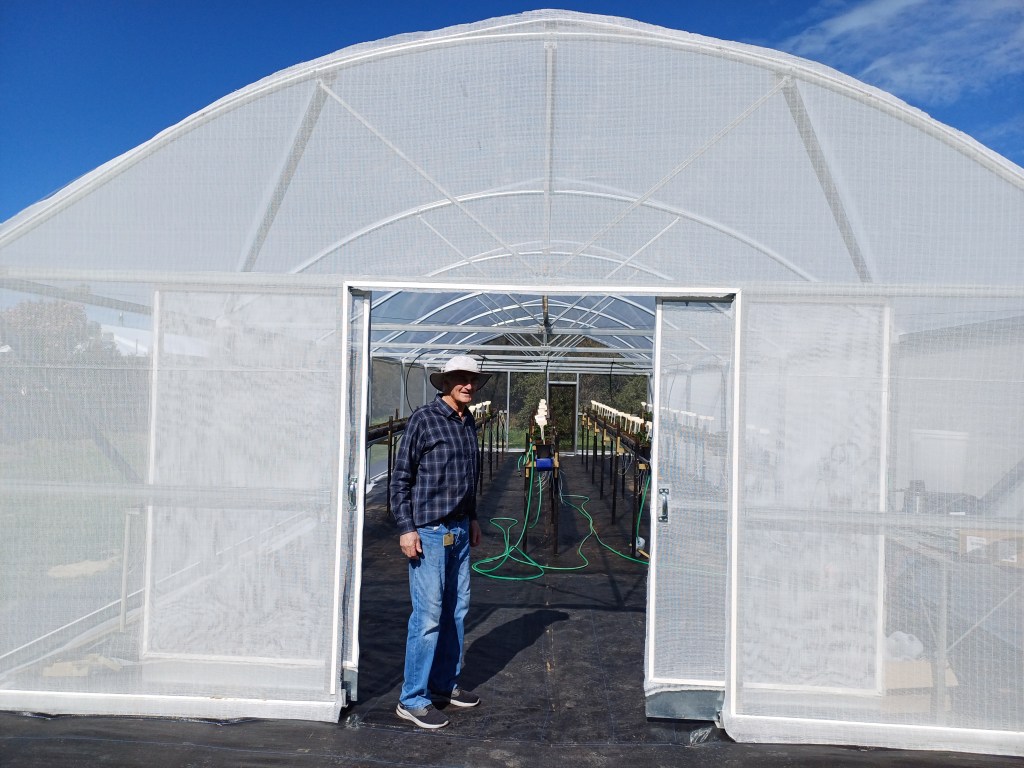
Berryworld has a new tunnel structure which we are using for the annual Lincoln strawberry variety trial. It’s small; 6 meters wide, 2 meters at the gutter and about 3 at the top of the hoop. The sides are mesh, in order to vent as much heat as possible. The top is a light-diffusing single layer of plastic, and the ground is covered in black landscape fabric.
Too much heat is bad for strawberry productivity
Already this season our temperature sensor is hitting 30°C on sunny days when outdoors is mid-low 20s. 30°C is too hot, and it’s only October. We know that high heat is bad for strawberry fruit production (see https://www.berryworld.co.nz/blog-posts/heat-is-bad-for-strawberries). We have received a timely bit of funding from the Horticentre Charitable Trust to has funded a small project to progress our understanding of heat reduction options. We’ll be working with some growers to quantify where the pinch points are in terms of heat under tunnel structures in strawberries, and sharing our learnings with the industry.
One of our well-known options for heat management under covers is to apply shading to the greenhouse roof. Of course, there is a trade-off between reducing total light which will reduce heat, and reducing photosynthesis.
So, what’s the sweet spot?
The conventional wisdom is that strawberries don’t use more than 30 mols/m2/day in sunlight to drive carbon capture. Helen Boldingh, BioEconomy Sciences Institute plant physiologist, explains it this way: In the morning as the sun comes up the plant gets busy using sunlight to convert carbon dioxide in the air into simple sugar molecules, which is then has to transport out of the leaves to the parts of the plant that need energy (growing points, fruits, etc). At some point, usually mid-afternoon, the “pipelines get full” of sugars and the plant has to pause photosynthesis and spend some time transporting sugars away from the leaves to make room for more photosynthates to be produced. This “plant productivity slump” often coincides with mid afternoon heat.
How much light do we get in the summer?
In December and January, Christchurch typically gets 45 mols/m2/day. That means that at some point mid afternoon, the plants get “full” and the extra light energy is just being converted to heat, which stresses the plants.
Below is a table showing the seasonal light levels outdoors in several regions of NZ. You can see that by October, we’re all receiving more than 30 mols/m2/day, and continue to do so (on average; clouds do vary) through March.

The way I’m looking at it, if 30 mols/m2/day is the maximum the strawberry plants will use, then on the sunniest months I can shade the roof, reducing heat stress, and hopefully not reducing overall productivity.
How much shading?
First, I need to work out how much shading the plastic already creates. The manufacturer says 91% of light is transmitted. However, I borrowed a light meter and found that it’s more like 80% transmission (20% shading).
The older the plastic, the less light it tends to transmit, as it gets dirty and weathered.
If I was to apply 15% shade to my plastic as whitewash, I’d be at 35% shading, which should bring the light accumulation down from the Dec/Jan highs of 45 mols/m2/day to just under 30 mols/m2/day.
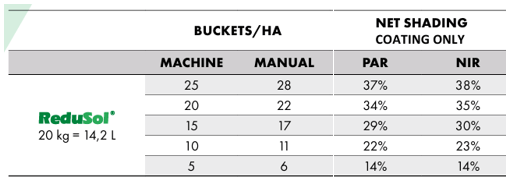
There are various brands of spray-on white wash; we have ReduSol on hand. ReduSol instructions say that using 5 buckets per hectare (in 2000L of total solution) gives 14% extra shade (on top of the 20% from the plastic coating itself). Together that makes 34% shading, which is about what I’m after.
A ReduSol bucket holds (14.2L). If I aim for 5 buckets (71L ReduSol) per hectare in 2000L of total solution, that’s 0.7 L of ReduSol in 19.3 L of water for my little 0.01 hectare (100m2) structure. I could use 1L ReduSol per 20L solution and be close.
The chart below is an excerpt from a ReduSystems brochure which shows the additional shading from applying ReduSol.
The Horticentre technical reps remind us of some practical considerations when using ReduSol. It wears off gradually in rain events, so if your location tends to get heavy rainfall events (like Auckland), you might want to reapply mid season, or start with a heavier coating. Reapplication is an opportunity to provide additional shading for Dec/Jan while not cutting out more light than ideal in spring.
After applying the shade, we will then assess the impact on the high afternoon temperatures. Stay tuned.