
Your trusted source for independent, high-quality, science-based advice
© 2025 Berryworld, All Rights Reserved

I know my audience is not squash growers. But bear with me—the squash industry, along with the Lighter Touch program, has just put a huge amount of effort into the management of soil-borne diseases. For strawberries, phytophthora is an insidious yield-drag, and we also contend with pythium, fusarium, verticilliums…the list goes on. The squash lessons are applicable to strawberries and other berry crops as well.
1. The list of soil-borne pathogens that feast on squash roots is long and complex, and often more than one malefactor is causing damage at the same time.
The same complexity of pathogens and multiple infections happens in strawberries.
2. After several years of growing squash and/or other susceptible crops in the same paddock, disease levels build up and squash crops suffer. When roots are being eaten by pathogens, plants can’t take up enough nutrients or water and the leaf canopies stunt and die back. Fruit quality suffers because the reduced canopy can’t support fruit growth with strong cell walls, making it more susceptible to infection by pathogens (often the same ones eating the roots), and fruit get sunburn.
The same canopy weakening and resulting lower productivity happens in strawberries, including plant collapse under severe infections.
The squash work highlighted that there is not a silver bullet for soil-borne pathogens. The management approach must integrate:
Strawberry growers generally manage the soil-borne pathogens with pre-plant fumigation. Since methyl bromide has been phased out, we’ve used a less effective but ozone-safer combination of soil fumigation chemicals. The costs of soil fumigation continue to rise, and fumigation is not 100% effective at keeping root pathogens at bay.
In NZ, annual strawberries are often grown in the same paddock year after year. Growers feel they have no other option if their land base is limited.
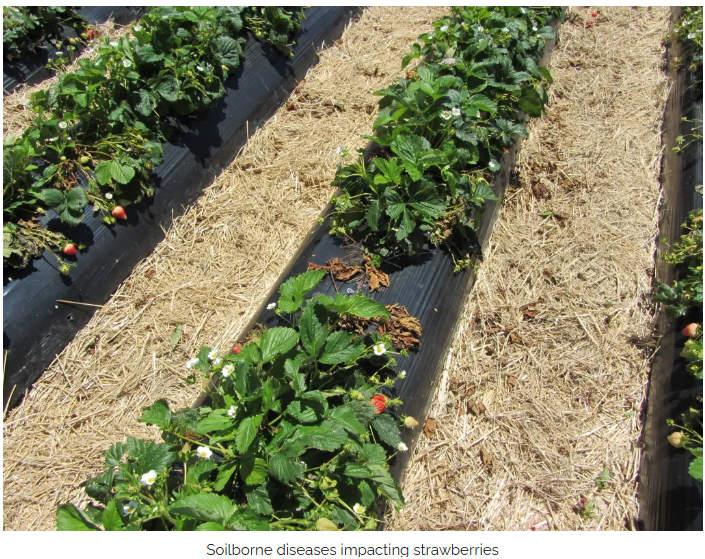
Often growers will have no idea what the cost of soil diseases is, because without a side-by-side comparison, you can’t see how much you’re losing. However, consider this realistic example. If root damage takes the average yield of a field-grown strawberry crop from 700g/plant down to 600g/plant (we have strong indications from our trials that this happens!) and 70,000 plants are grown per hectare with fruit worth an average of $10/kg, the yield loss is $70,000 worth of fruit (70,000 plants/ha x 0.1kg/plant x $10/kg).
That suggests a $70k incentive to get a little bit more creative with crop rotations.
I used to work with a smart potato farmer when I lived in the states. Growing potatoes is hard on soil structure, similar to strawberries—the crop doesn’t return a lot of organic matter to the soil, requires a lot of soil disturbance with mounding harvesting, as well as heavy equipment passes. Growing potatoes was profitable, but soil-borne diseases were taking their toll. Also, the compacted, ponding areas of the block continued to expand, making field access difficult.
Seeing this, the grower chose a three-year rotation that incorporated grain corn (lots of organic matter returning, unlike sileage), a service crop of sorghum (no marketable crop but huge organic matter additions), and potatoes.
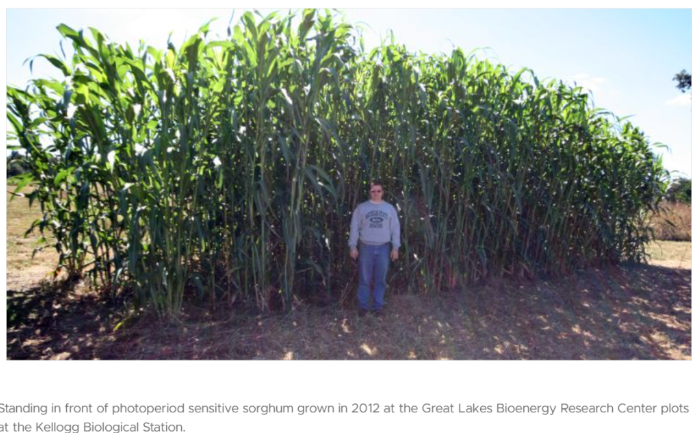
It took some years, but the puddles shrunk and soil health improved. He has since switched to a more complicated rotation that uses the cool shoulder seasons better, as well as adds nitrogen. He has been innovative, willing to experiment, and willing to set aside some time in the rotation that doesn’t result in a cash crop. It has paid off with fewer tuber diseases in the potatoes and better ability to get field work done on time because soil drainage has improved.
If I was thinking about rotation options for strawberries, I’d be starting with grass-family plants like corn or the cereal grains, as well as the brassica family like mustards. There are always trade-offs in the choice of species, but the goal is to use ones that don’t have the same pathogens as strawberries. A main goal is to return a lot of organic matter to the soil, so resist the temptation to rely on short-season forage crops where the animals eat most of the carbon. Perennial forages, on the other hand, with their combination of no till and a fibrous root systems, do tend to build soil organic matter.
So, before you write off crop rotation as impossible, have a read of the Squash soil borne pathogen lessons, and think about renting some land off the neighbour in order to expand the rotational sequence with strawberries.