
Your trusted source for independent, high-quality, science-based advice
© 2025 Berryworld, All Rights Reserved

We planted our Lincoln variety trial in September, a tabletop system with a coir/peat media in troughs. Since planting I’ve been trying to work out the irrigation settings, with the goal of keeping the media moisture in the “sweet zone” of not too dry and not too wet. Our added challenge is that this is a variety trial so there is considerable variation in plant size plot-by-plot. The bigger canopies suck the soil dry much faster than smaller ones.
I’m appreciating how much daily adjustments are required!
We chose to put slow-release fertilizer in the mix (5kg/m3 ‘Osmocote 5-6 month High K’), which would be a somewhat unusual choice for commercial strawberry growers. When planting in the winter I like this because it means that I don’t have to add water in order to have nutrients in the root zone. With the low light and cold temperature in the winter, we often don’t want to add water to the media.
However, this year we planted in mid September, and we have had the full gamut of typical spring weather since then! Record winds in Canterbury, hot sunny days followed rapidly by a southerly change and single digit highs.
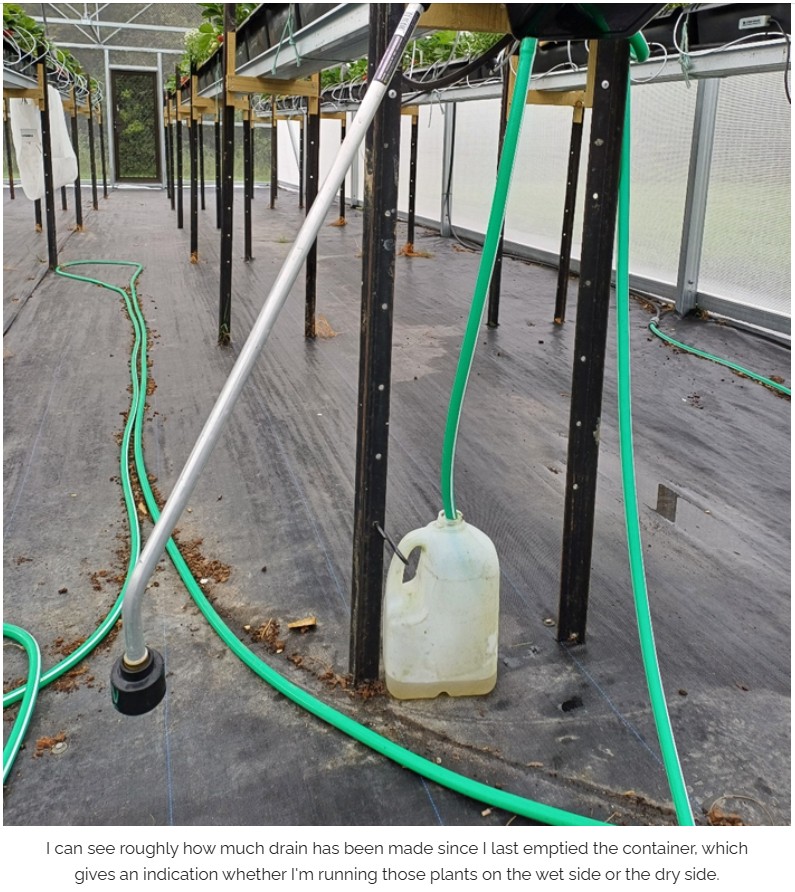
I’ve chosen to give water in 2 minute increments, several times per day. Drippers deliver 2L/hour and I have 1 dripper every 2 plants, so 2 minutes gives 30 ml per plant. I collect the drain water, so I can see roughly how much is excess. In the above watering scenario, 2.4L drain a day is 10% of the water delivered. I’d like to have an automatic drain measuring system, but we’re not quite there yet.
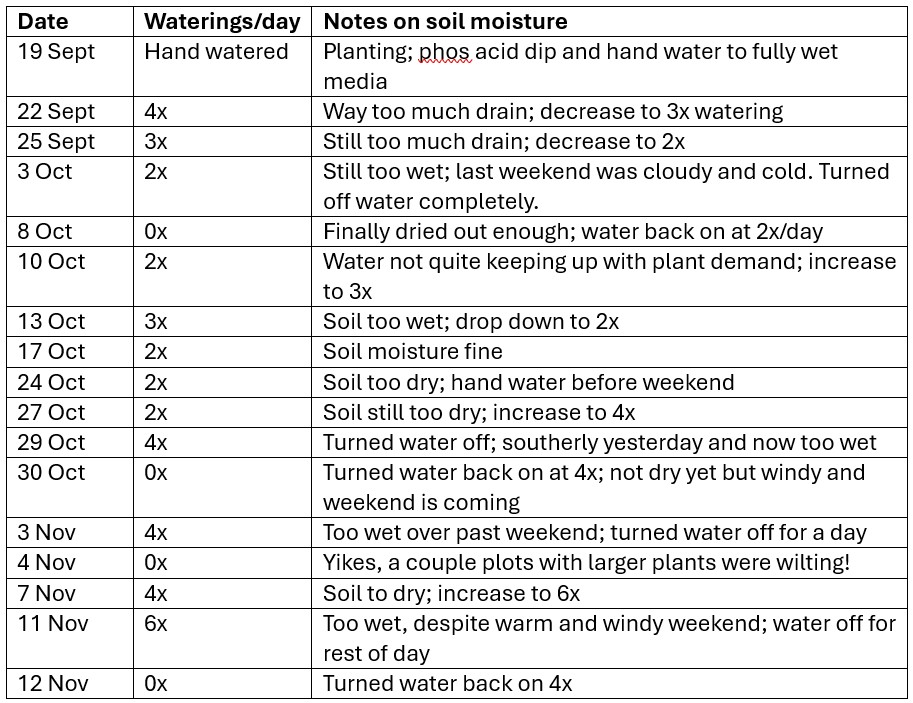
The EC in the media was initially plenty high from the slow-release fert so I was just monkeying with the clear watering schedule. The diary tells the story!
When I look at the evapotranspiration over the last 2 months, I can appreciate why the watering takes so much adjustment. A rainy southerly day can be followed by a day with 3-4 times the evapotranspiration rate.
The chart below shows the evapotranspiration over the last month—high evapotranspiration days were actually higher because the model below doesn’t take wind into account.


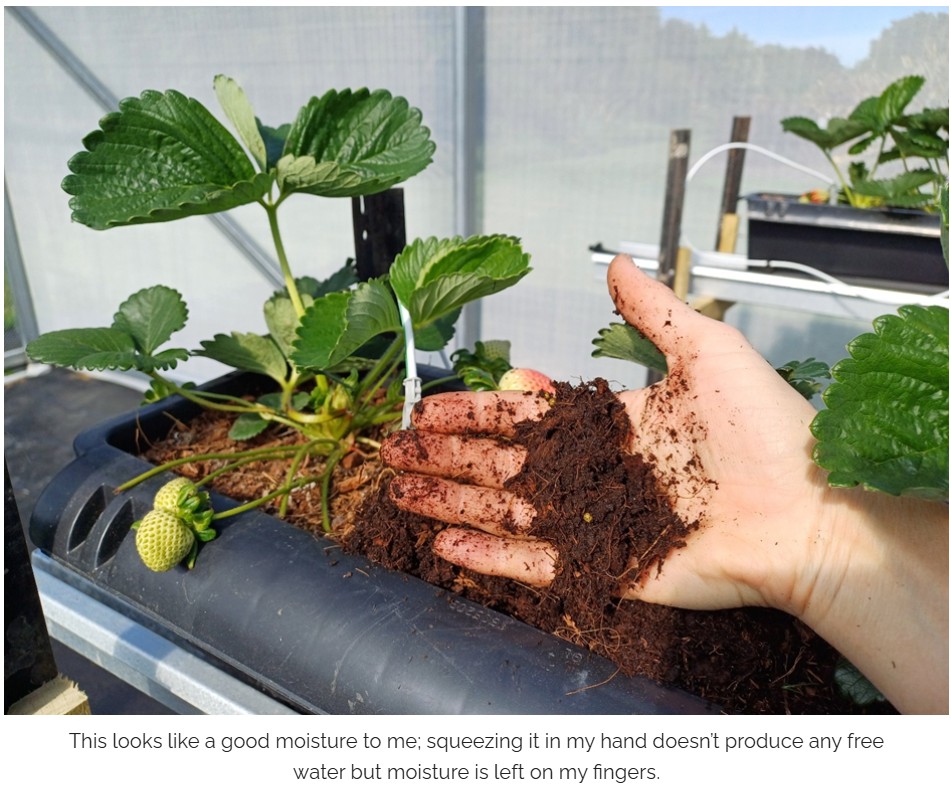
The soil moisture tracking above shows where the roots got too dry, and where they were too wet. For this sensor, we judge that 36.5% Volumetric Water Content is container is “container capacity.” I reckon that 34% is about right, and 30% is drier than I’m comfortable with in the summer. The percentages arecompletely arbitrary and not transferable to other media or containers; I’ve had to feel soil and match it to what the graph is showing.
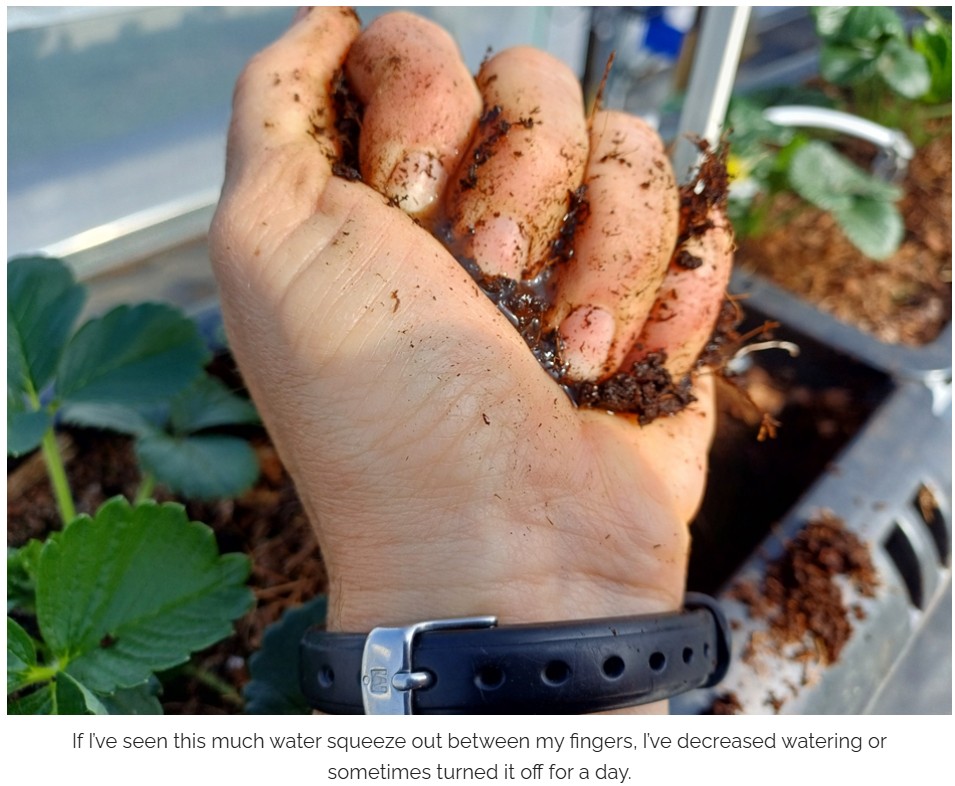
This looks like a good moisture to me; squeezing it in my hand doesn’t produce any free water but moisture is left on my fingers.

This exercise has made me appreciate that a “set and forget” watering strategy is wishful thinking. By far the simplest strategy is to constantly overwater, creating a lot of drain and relying on the porous media to keep the roots aerated. The trouble with this strategy is that it can make roots lazy (not grow throughout the whole media in search of moisture), as well as leading to root rot, so plants are less resilient when it does get hot and dry. Some varieties seem to really suffer from soft fruit and loss of flavour with this approach as well.
The risk of underwatering is that chronic water shortage results in smaller fruit and less yield. This is well documented by researchers looking at “deficit irrigation” strategies. Fruit quality does increase (sugars, anthocyanins), but berry size goes down significantly (as much as 20-30% smaller berries).
The theory is that occasionally giving plants a little mild water stress will actually increase flower production (a ‘generative’ growing strategy, as the Europeans would say). Without a doubt that is a fine line to hit and requires frequent monitoring and adjustment.
See the SGNZ Growers Guide to Nutrient Management for more information.